21 posts tagged with "oci"

View All Tags

Cloud-Native AI Model Management and Distribution for Inference Workloads

· 12 min read

Author:

  • Wenbo Qi(Gaius), Dragonfly/ModelPack Maintainer
  • Chenyu Zhang(Chlins), Harbor/ModelPack Maintainer
  • Feynman Zhou, ORAS Maintainer, CNCF Ambassador

Reviewer:

  • Sascha Grunert, CRI-O Maintainer
  • Wei Fu, containerd Maintainer

The weight of AI models: Why infrastructure always arrives slowly

As AI adoption accelerates across industries, organizations face a critical bottleneck that is often overlooked until it becomes a serious obstacle: reliably managing and distributing large model weight files at scale. A model's weights serve as the central artifact that bridges both training and inference pipelines — yet the infrastructure surrounding this artifact is frequently an afterthought.

This article addresses the operational challenges of managing AI model artifacts at enterprise scale, and introduces a cloud-native solution that brings software delivery best practices — versioning, immutability, and GitOps, to the world of large model files.

The gap nobody talks about — until it breaks production

The cloud native gap: Most existing ML model storage approaches were not designed with Kubernetes-native delivery in mind, leaving a critical gap between how software artifacts are managed and how model artifacts are managed.

Today, enterprises operate AI infrastructure on Kubernetes yet their model artifact management lags behind. Software containers are pulled from OCI registries with full versioning, security scanning, and rollback support. Model weights, by contrast, are often downloaded via ad hoc scripts, copied manually between storage buckets, or distributed through unsecured shared filesystems. This gap creates deployment fragility, security risks, and operational overhead at scale.

When your model weighs more than your entire app

Modern foundation models are not small. A single model checkpoint can range from tens of gigabytes to several terabytes. For reference, a quantized LLaMA-3 70B model weighs approximately 140 GB, while frontier multimodal models can easily exceed 1 TB. These are not files you version-control with standard Git — they demand dedicated storage strategies, efficient transfer protocols, and careful access control.

The core challenges are: storage at scale, distribution speed, and reproducibility. Teams need to store multiple model versions, rapidly distribute them to GPU inference nodes across regions, and guarantee that any deployment can be traced back to an exact, immutable artifact.

Three paths forward — and why none of them are enough

Git LFS (Hugging Face Hub)Object Storage (S3, MinIO)Distributed Filesystem (NFS, CephFS)
ProsNative version control (branches, tags, commits, history).Standard offering from cloud providers. Native support in engines like vLLM/SGLang.POSIX compatible. Low integration cost.
ConsPoor protocol adaptation for cloud-native environments. Inherits Git's transport inefficiencies, lacks optimizations for huge file distribution.Lacks structured metadata. Weak version management capabilities.Lacks structured metadata. Weak version management capabilities. High operational complexity for distributed filesystem.

Rethinking the delivery pipeline: Models deserve better than a shell script

The approach described here treats AI model weights as first-class OCI (Open Container Initiative) artifacts, packaging them in the same container registries used for application images. This enables model delivery to leverage the full ecosystem of container tooling: security scanning, signed provenance, GitOps-driven deployment, and Kubernetes-native pulling.

What If we shipped models the same way we ship code?

In the cloud-native era, developers have long established a mature and efficient paradigm for software delivery.

p1

The software delivery:

  1. Develop: Developers commit code to a Git repository, manage code changes through branches, and define versions using tags at key milestones.
  2. Build: CI/CD pipelines compile and test, packaging the output into an immutable Container Image.
  3. Manage and deliver: Images are stored in a Container Registry. Supply chain security (scanning/signing), RBAC, and P2P distribution ensure safe delivery.
  4. Deploy: DevOps engineers use declarative Kubernetes YAML to define the desired state. The Container's lifecycle is managed by Kubernetes.

p2

The cloud native AI model delivery:

  1. Develop: Algorithm engineers push weights and configs to the Hugging Face Hub, treating it as the Git Repository.
  2. Build: CI/CD pipelines package weights, runtime configurations, and metadata into an immutable Model Artifact.
  3. Manage and deliver: The Model Artifact is managed by an Artifact Registry, reusing the existing container infrastructure and toolchain.
  4. Deploy: Engineers use Kubernetes OCI Volumes or a Model CSI Driver. Models are mounted into the inference Container as Volumes via declarative semantics, decoupling the AI model from the inference engine (vLLM, SGLang, etc.).

By applying software delivery paradigms and supply chain thinking to model lifecycle management, we constructed a granular, efficient system that resolves the challenges of managing and distributing AI models in production.

Walking the pipeline: A build story in four steps

Build

modctl is a CLI tool designed to package AI models into OCI artifacts. It standardizes versioning, storage, distribution and deployment, ensuring integration with the cloud-native ecosystem.

p3

Step 1: Auto-generate Modelfile

Run the following in the model directory to generate a definition file.

modctl modelfile generate .
Step 2: Customize Modelfile

You can also customize the content of the Modelfile.

# Model name (string), such as llama3-8b-instruct, gpt2-xl, qwen2-vl-72b-instruct, etc.
NAME qwen2.5-0.5b

# Model architecture (string), such as transformer, cnn, rnn, etc.
ARCH transformer

# Model family (string), such as llama3, gpt2, qwen2, etc.
FAMILY qwen2

# Model format (string), such as onnx, tensorflow, pytorch, etc.
FORMAT safetensors

# Specify model configuration file, support glob path pattern.
CONFIG config.json

# Specify model configuration file, support glob path pattern.
CONFIG generation_config.json

# Model weight, support glob path pattern.
MODEL *.safetensors

# Specify code, support glob path pattern.
CODE *.py
Step 3: Login to Artifact Registry (Harbor)
modctl login -u username -p password harbor.registry.com
Step 4: Build OCI Artifact
modctl build -t harbor.registry.com/models/qwen2.5-0.5b:v1 -f Modelfile .

A Model Manifest is generated after the build. Descriptive information such as ARCH, FAMILY, and FORMAT is stored in a file with the media type application/vnd.cncf.model.config.v1+json.

{
"schemaVersion": 2,
"mediaType": "application/vnd.oci.image.manifest.v1+json",
"artifactType": "application/vnd.cncf.model.manifest.v1+json",
"config": {
"mediaType": "application/vnd.cncf.model.config.v1+json",
"digest": "sha256:d5815835051dd97d800a03f641ed8162877920e734d3d705b698912602b8c763",
"size": 301
},
"layers": [
{
"mediaType": "application/vnd.cncf.model.weight.v1.raw",
"digest": "sha256:3f907c1a03bf20f20355fe449e18ff3f9de2e49570ffb536f1a32f20c7179808",
"size": 4294967296
},
{
"mediaType": "application/vnd.cncf.model.weight.v1.raw",
"digest": "sha256:6d923539c5c208de77146335584252c0b1b81e35c122dd696fe6e04ed03d7411",
"size": 5018536960
},
{
"mediaType": "application/vnd.cncf.model.weight.config.v1.raw",
"digest": "sha256:a5378e569c625f7643952fcab30c74f2a84ece52335c292e630f740ac4694146",
"size": 106
},
{
"mediaType": "application/vnd.cncf.model.weight.code.v1.raw",
"digest": "sha256:15da0921e8d8f25871e95b8b1fac958fc9caf453bad6f48c881b3d76785b9f9d",
"size": 394
},
{
"mediaType": "application/vnd.cncf.model.doc.v1.raw",
"digest": "sha256:5e236ec37438b02c01c83d134203a646cb354766ac294e533a308dd8caa3a11e",
"size": 23040
}
]
}
Step 5: Push
modctl push harbor.registry.com/models/qwen2.5-0.5b:v1

Management

Current AI infrastructure workflows focus heavily on model distribution performance, often ignoring model management standards. Manual copying works for experiments, but in large-scale production, lacking unified versioning, metadata specs, and lifecycle management is poor practice. As the standard cloud-native Artifact Registry, Harbor is ideally suited for model storage, treating models as inference artifacts.

Harbor standardizes AI model management through:

  • Versioning: Models are OCI Artifacts with immutable Tags and Sha256 Digests. This guarantees deterministic inference environments. Meanwhile, it visually presents the model's basic attributes, parameter configurations, display information, and the file list, which not only reduce the risks of unknown versions but also achieves full transparency of the model.

p4

  • RBAC: Fine-grained access control. Control who can PUSH (e.g., Algorithm Engineers), who can only PULL (e.g., Inference Services), and who has administrative privileges.

p5

  • Lifecycle management: Tag retention policies automatically purge non-release versions while locking active versions, balancing storage costs with stability.

p6

  • Supply chain security: Integration with Cosign/Notation for signing. Harbor enforces signature verification before distribution, preventing model poisoning attacks.

p7

  • Replication: Automated, incremental synchronization between central and edge registries or active-standby clusters.

p8

  • Audit: Comprehensive logging of all artifact operations (pull/push/delete) for security compliance and traceability.

p9

Delivery

Downloading terabyte-sized model weights directly from the origin introduces bandwidth bottlenecks. We utilize Dragonfly for P2P-based distribution, integrated with Harbor for preheating.

p10

Dragonfly P2P-based distribution

For large-scale distribution scenarios, Dragonfly has been deeply optimized based on P2P technology. Taking the example of 500 nodes downloading a 1TB model, the system distributes the initial download tasks of different layers across nodes to maximize downstream bandwidth utilization and avoid single-point congestion. Combined with a secondary bandwidth-aware scheduling algorithm, it dynamically adjusts download paths to eliminate network hotspots and long-tail latency. For individual model weight, Dragonfly splits individual model weights into pieces and fetches them concurrently from the origin. This enables streaming-based downloading, allowing users to share models without waiting for the complete file. This solution has been proven in high-performance AI clusters, utilizing 70%-80% of each node's bandwidth and improving model deployment efficiency.

p11

Preheating

For latency-sensitive inference services, Harbor triggers Dragonfly to distribute and cache data on target nodes before service scaling. When the instance starts, the model loads from the local disk, achieving zero network latency.

p12

Deployment

Deployment focuses on decoupling the Model (Data) from the Inference Engine (Compute). By leveraging Kubernetes declarative primitives, the Engine runs as a Container, while the Model is mounted as a Volume. This native approach not only enables multiple Pods on the same node to share and reuse the model, saving disk space, but also leverages the preheating and P2P capabilities of Harbor & Dragonfly to eliminate the latency of pulling large model weights, significantly improving startup speed.

p13

OCI Volumes (Kubernetes 1.31+)

Native support for mounting OCI artifacts as volumes via CRI-O/containerd. This feature was introduced as alpha in Kubernetes 1.31 (requires enabling the ImageVolume feature gate) and promoted to beta in Kubernetes 1.33 (enabled by default, no feature gate configuration needed). CRI-O specifically enhances this for LLMs by avoiding decompression overhead at mount time by storing layers uncompressed, resulting in superior performance when mounting large model files.

Step 1: Build YAML
apiVersion: v1
kind: Pod
metadata:
name: vllm-cpu-inference
labels:
app: vllm
spec:
containers:
- name: vllm
image: openeuler/vllm-cpu:latest
command:
- 'python3'
- '-m'
- 'vllm.entrypoints.openai.api_server'
args:
- '--model'
- '/models'
- '--dtype'
- 'float32'
- '--host'
- '0.0.0.0'
- '--port'
- '8000'
- '--max-model-len'
- '1024'
- '--disable-log-requests'
env:
- name: VLLM_CPU_KVCACHE_SPACE
value: '1'
- name: VLLM_WORKER_MULTIPROC_METHOD
value: 'spawn'
resources:
requests:
memory: '2Gi'
cpu: '1'
limits:
memory: '16Gi'
cpu: '8'
volumeMounts:
- name: model-volume
mountPath: /models
readOnly: true
ports:
- containerPort: 8000
protocol: TCP
name: http
livenessProbe:
httpGet:
path: /health
port: 8000
initialDelaySeconds: 60
periodSeconds: 10
timeoutSeconds: 5
readinessProbe:
httpGet:
path: /health
port: 8000
initialDelaySeconds: 30
periodSeconds: 5
volumes:
- name: model-volume
image:
reference: ghcr.io/chlins/qwen2.5-0.5b:v1
pullPolicy: IfNotPresent
---
apiVersion: v1
kind: Service
metadata:
name: vllm-service
spec:
selector:
app: vllm
ports:
- port: 8000
targetPort: 8000
protocol: TCP
name: http
type: ClusterIP
Step 2: Deploy inference Workload

p14

Step 3: Call Inference Workload

p15

Model CSI Driver

For compatibility with Kubernetes 1.31 and older, we offer the Model CSI Driver as an interim solution to mount and deploy models as volumes. As OCI Volumes are slated for GA in Kubernetes 1.36, shifting to native OCI Volumes is recommended for the long term.

Step 1: Build YAML
apiVersion: v1
kind: Pod
metadata:
name: vllm-cpu-inference
labels:
app: vllm
spec:
containers:
- name: vllm
image: openeuler/vllm-cpu:latest
command:
- 'python3'
- '-m'
- 'vllm.entrypoints.openai.api_server'
args:
- '--model'
- '/models'
- '--dtype'
- 'float32'
- '--host'
- '0.0.0.0'
- '--port'
- '8000'
- '--max-model-len'
- '1024'
- '--disable-log-requests'
env:
- name: VLLM_CPU_KVCACHE_SPACE
value: '1'
- name: VLLM_WORKER_MULTIPROC_METHOD
value: 'spawn'
resources:
requests:
memory: '2Gi'
cpu: '1'
limits:
memory: '16Gi'
cpu: '8'
volumeMounts:
- name: model-volume
mountPath: /models
readOnly: true
ports:
- containerPort: 8000
protocol: TCP
name: http
livenessProbe:
httpGet:
path: /health
port: 8000
initialDelaySeconds: 60
periodSeconds: 10
timeoutSeconds: 5
readinessProbe:
httpGet:
path: /health
port: 8000
initialDelaySeconds: 30
periodSeconds: 5
volumes:
- name: model-volume
csi:
driver: model.csi.modelpack.org
volumeAttributes:
model.csi.modelpack.org/reference: ghcr.io/chlins/qwen2.5-0.5b:v1
---
apiVersion: v1
kind: Service
metadata:
name: vllm-service
spec:
selector:
app: vllm
ports:
- port: 8000
targetPort: 8000
protocol: TCP
name: http
type: ClusterIP
Step 2: Deploy Inference Workload

p14

Step 3: Call Inference Workload

p15

Future

  • Enhanced Preheating: Allow models to be preheated to specified nodes and querying cache distribution across nodes for model-aware pod scheduling.
  • Dragonfly RDMA Acceleration: Enable Dragonfly to utilize InfiniBand or RoCE to improve the speed of distribution.
  • Lazy Loading: Implement on-demand downloading of model weights to reduce startup latency.
  • containerd Optimization: Enhance the OCI Volumes implementation to reduce decompression overhead for large layers.
  • Model Security Scanning: Introduce deep scanning capabilities specifically designed for model weights to detect embedded malicious payloads.

Collaborative Projects

References

Cloud Native Computing Foundation Announces Dragonfly’s Graduation

· 11 min read

Dragonfly graduates after demonstrating production readiness, powering container and AI workloads at scale.

Key Highlights:

  • Dragonfly graduates from CNCF after demonstrating production readiness and widespread adoption across container and AI workloads.
  • Dragonfly is used by major organizations, including Ant Group, Alibaba, Datadog, DiDi, and Kuaishou to power large-scale container and AI model distribution.
  • Since joining the CNCF, Dragonfly is backed by over a 3,000% growth in code contributions and a growing contributor community spanning over 130 companies.

SAN FRANCISCO, Calif. – January 14, 2026 – The Cloud Native Computing Foundation® (CNCF®), which builds sustainable ecosystems for cloud native software, today announced the graduation of Dragonfly, a cloud native open source image and file distribution system designed to solve cloud native image distribution in Kubernetes-centered applications.

“Dragonfly’s graduation reflects the project’s maturity, broad industry adoption and critical role in scaling cloud native infrastructure,” said Chris Aniszczyk, CTO, CNCF. “It’s especially exciting to see the project’s impact in accelerating image distribution and meeting the data demands of AI workloads. We’re proud to support a community that continues to push forward scalable, efficient and open solutions.”

Dragonfly’s Technical Capabilities

Dragonfly delivers efficient, stable, and secure data distribution and acceleration powered by peer-to-peer (P2P) technology. It aims to provide a best‑practice, standards‑based solution for cloud native architectures to improve large‑scale delivery of files, container images, OCI artifacts, AI models, caches, logs, and dependencies.

Dragonfly runs on Kubernetes and is installed via Helm, with its official chart available on Artifact Hub. It also includes tools like Prometheus for tracking performance, OpenTelemetry for collecting and sharing data, and gRPC for rapid communication between parts. Enhancing Harbor capability to distribute images and OCI artifacts through the preheat feature. In the GenAI era, as model serving becomes increasingly important, Dragonfly delivers even more value by distributing AI model artifacts defined by the ModelPack specification.

Dragonfly continues to advance container image distribution, supporting tens of millions of container launches per day in production, saving storage bandwidth by up to 90%, and reducing launch time from minutes to seconds, with large-scale adoption across different cloud native scenarios.

Dragonfly is also driving standards and acceleration solutions for distributing both AI model weights and optimized image layout in AI workloads. The technology reduces data loading for large-scale AI applications and enables the distribution of model weights at a hundred-terabyte scale to hundreds of nodes in minutes. As AI continues to integrate into operations, Dragonfly becomes crucial to powering large-scale AI workloads.

Milestones Driving Graduation

Dragonfly was open-sourced by Alibaba Group in November 2017. It then joined the CNCF as a Sandbox project in October 2018. During this stage, Dragonfly 1.0 became production-ready in November 2019 and the Dragonfly subproject, Nydus, was open-sourced in January 2020. Dragonfly then reached Incubation phase in April 2020, with Dragonfly 2.0 later released in 2021.

Since then, the community has significantly matured and attracted hundreds of contributors from organizations such as Ant Group, Alibaba Cloud, ByteDance, Kuaishou, Intel, Datadog, Zhipu AI, and more, who use Dragonfly to deliver efficient image and AI model distribution.

Since joining CNCF, contributors have increased by 500%, from 45 individuals across 5 companies to 271 individuals across over 130 companies. Commit activity has grown by over 3,000%, from roughly 800 to 26,000 commits, and the number of overall participants has reached 1,890.

What’s Next For Dragonfly

Dragonfly will accelerate AI model weight distribution based on RDMA, improving throughput and reducing end-to-end latency. It will also optimize image layout to reduce data loading time for large-scale AI workloads. A load-aware two-phase scheduling will be introduced, leveraging collaboration between the scheduler and clients to enhance overall distribution efficiency. To provide more stable and reliable services, Dragonfly will support automatic updates and fault recovery, ensuring stable operation of all components during traffic bursts while controlling back-to-source traffic.

Dragonfly’s Graduation Process

To officially graduate from Incubation status, the Dragonfly team enhanced the election policy, clarified the maintainer lifecycle, standardized the contribution process, defined the community ladder, and added community guidelines for subprojects. The graduation process is supported by CNCF’s Technical Oversight Committee (TOC) sponsors for Dragonfly, Karena Angell and Kevin Wang, who conducted a thorough technical due diligence with Dragonfly’s project maintainers.

Additionally, a third-party security audit of Dragonfly was conducted. The Dragonfly team along with the guidance of their TOC sponsors, completed both a self-assessment and a joint assessment with CNCF TAG Security, then collaborated with the Dragonfly security team on a threat model. After this, the team improved the project’s security policy.

Learn more about Dragonfly and join the community: https://d7y.io/

Supporting Quotes

“I am thrilled, as the founder of Dragonfly, to announce its graduation from the CNCF. We are grateful to each and every open source contributor in the community, whose tenacity and commitment have enabled Dragonfly to reach its current state. Dragonfly was created to resolve Alibaba Group’s challenges with ultra-large-scale file distribution and was open-sourced in 2017. Looking back on this journey over the past eight years, every step has embodied the open source spirit and the tireless efforts of the many contributors. This graduation marks a new starting point for Dragonfly. I hope that the project will embark on a new journey, continue to explore more possibilities in the field of data distribution, and provide greater value!”

—Zuozheng Hu, founder of Dragonfly, emeritus maintainer

“I am delighted that Dragonfly is now a CNCF graduated project. This is a significant milestone, reflecting the maturity of the community, the trust of end users, and the reliability of the service. In the future, with the support of CNCF, the Dragonfly team will work together to drive the community’s sustainable growth and attract more contributors. Facing the challenges of large-scale model distribution and data distribution in the GenAI era, our team will continue to explore the future of data distribution within the cloud native ecosystem.”

—Wenbo Qi (Gaius), core Dragonfly maintainer

“Since open-sourcing in 2020, Nydus, alongside Dragonfly, has been validated at production scale. Dragonfly’s graduation is a key milestone for Nydus as a subproject, allowing the project to continue improving the image filesystem’s usability and performance. It will also allow us to further explore ecosystem standardization and AGI use cases that will advance the underlying infrastructure.”

—Song Yan, core Nydus maintainer

“The combination of Dragonfly and Nydus substantially shortens launch times for container images and AI models, enhancing system resilience and efficiency.”

—Jiang Liu, Nydus maintainer

“Thanks to the community’s collective efforts, Dragonfly has evolved from a tool for accelerating container images into a secure and stable distribution system widely adopted by many enterprises. Continuous improvements in usability and stability enable the project to support a variety of scenarios, including CI/CD, edge computing, and AI. New challenges are emerging for the distribution of model weights and data in the age of AI. Dragonfly is becoming a key infrastructure in mitigating these challenges. With the support of the CNCF, Dragonfly will continue to drive the future evolution of cloud native distribution technologies.”

—Yuan Yang, Dragonfly maintainer

Triton Server accelerates distribution of models based on Dragonfly

· 10 min read

CNCF projects highlighted in this post, and migrated by mingcheng.

Project post by Yufei Chen, Miao Hao, and Min Huang, Dragonfly project

This document will help you experience how to use dragonfly with TritonServe. During the downloading of models, the file size is large and there are many services downloading the files at the same time. The bandwidth of the storage will reach the limit and the download will be slow.
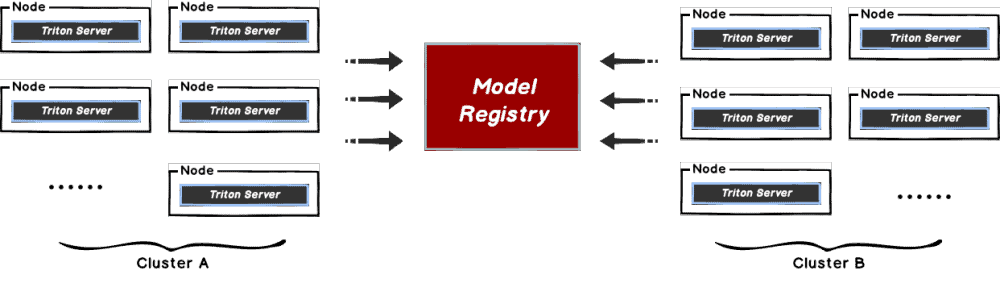
Diagram flow showing nodes in Triton Server in Cluster A and Cluster B to Model Registry

Dragonfly can be used to eliminate the bandwidth limit of the storage through P2P technology, thereby accelerating file downloading.
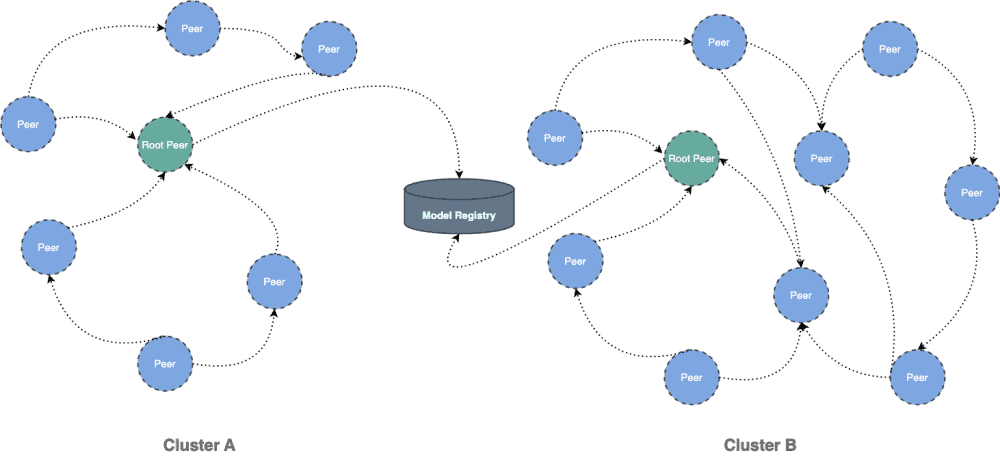
Diagram flow showing Cluster A and Cluster B Peer to Root Peer to Model Registry

Dragonfly accelerates distribution of large files with Git LFS

· 11 min read

CNCF projects highlighted in this post, and migrated by mingcheng.

What is Git LFS?

Git LFS (Large File Storage) is an open-source extension for Git that enables users to handle large files more efficiently in Git repositories. Git is a version control system designed primarily for text files such as source code and it can become less efficient when dealing with large binary files like audio, videos, datasets, graphics and other large assets. These files can significantly increase the size of a repository and make cloning and fetching operations slow.
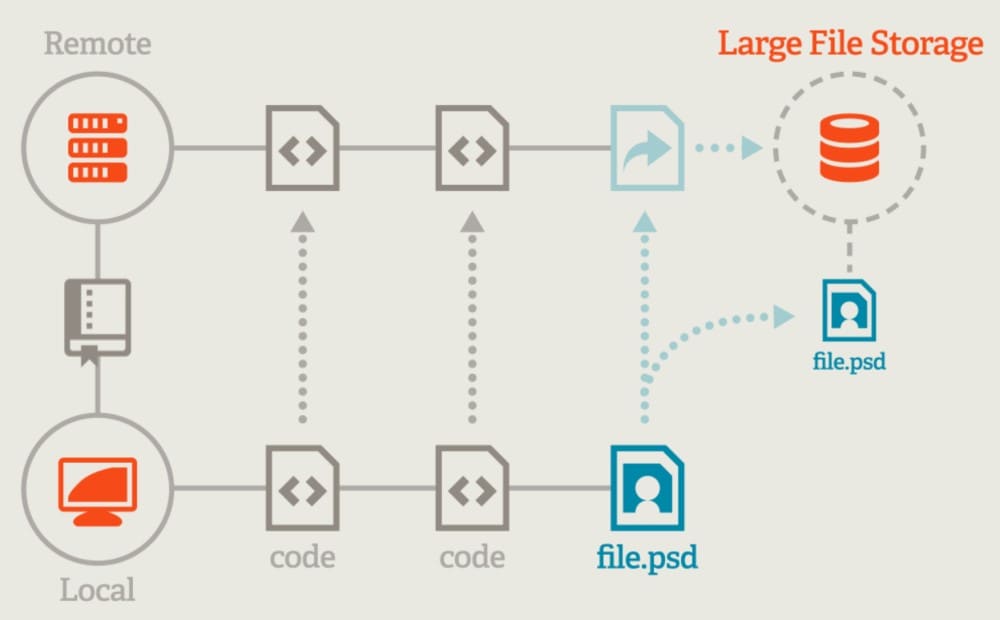
Diagram flow showing Remote to Large File Storage

Git LFS addresses this issue by storing these large files on a separate server and replacing them in the Git repository with small placeholder files (pointers). When a user clones or pulls from the repository, Git LFS fetches the large files from the LFS server as needed rather than downloading all the large files with the initial clone of the repository. For specifications, please refer to the Git LFS Specification. The server is implemented based on the HTTP protocol, refer to Git LFS API. Usually Git LFS’s content storage uses object storage to store large files.

Git LFS Usage

Git LFS manages large files

GitHub and GitLab usually manage large files based on Git LFS.

Git LFS manages AI models and AI datasets

Large files of models and datasets in AI are usually managed based on Git LFS. Hugging Face Hub and ModelScope Hub manage models and datasets based on Git LFS.

Hugging Face Hub’s Python Library implements Git LFS to download models and datasets. Hugging Face Hub’s Python Library distributes models and datasets to accelerate, refer to Hugging Face accelerates distribution of models and datasets based on Dragonfly.

Dragonfly eliminates the bandwidth limit of Git LFS’s content storage

This document will help you experience how to use dragonfly with Git LFS. During the downloading of large files, the file size is large and there are many services downloading the larges files at the same time. The bandwidth of the storage will reach the limit and the download will be slow.
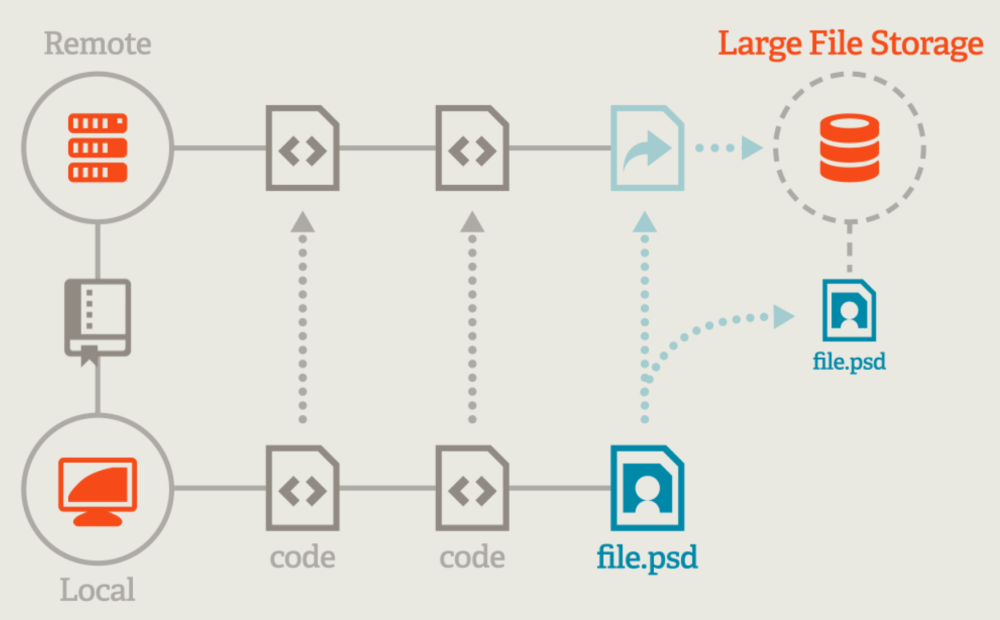
Diagram flow showing Cluster A and Cluster B  to Large File Storage

Dragonfly can be used to eliminate the bandwidth limit of the storage through P2P technology, thereby accelerating large files downloading.
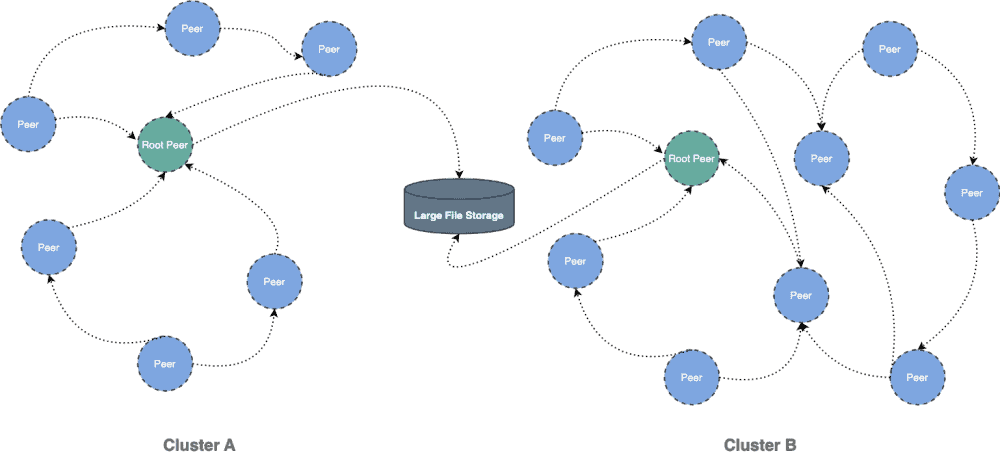
Diagram flow showing Cluster A and Cluster B  to Large File Storage using Peer and Root Peer

TorchServe accelerates the distribution of models based on Dragonfly

· 14 min read

CNCF projects highlighted in this post, and migrated by mingcheng.

This document will help you experience how to use dragonfly with TorchServe. During the downloading of models, the file size is large and there are many services downloading the files at the same time. The bandwidth of the storage will reach the limit and the download will be slow.
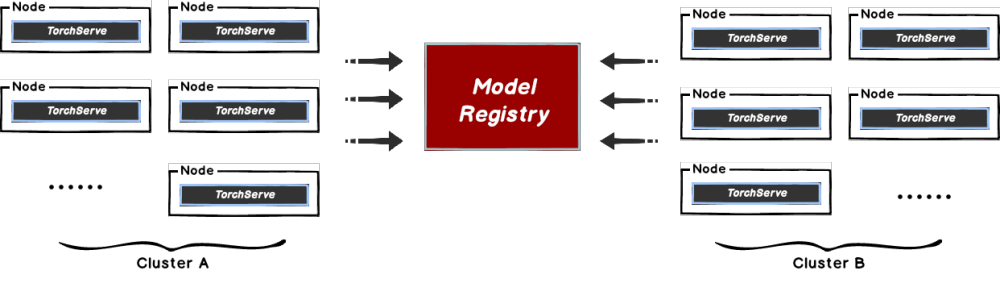
Diagram flow showing Model Registry flow from Cluster A and Cluster B

Dragonfly can be used to eliminate the bandwidth limit of the storage through P2P technology, thereby accelerating file downloading.
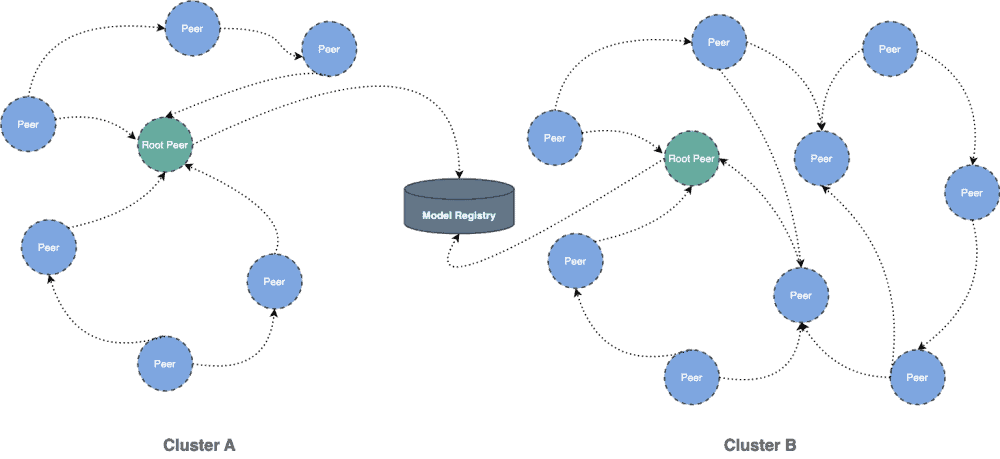
Diagram flow showing Model Registry flow from Cluster A and Cluster B

Hugging Face accelerates distribution of models and datasets based on Dragonfly

· 10 min read

CNCF projects highlighted in this post, and migrated by mingcheng.

This document will help you experience how to use dragonfly with hugging face. During the downloading of datasets or models, the file size is large and there are many services downloading the files at the same time. The bandwidth of the storage will reach the limit and the download will be slow.

Diagram flow showing Hugging Face Hub flow from Cluster A and Cluster B

Dragonfly can be used to eliminate the bandwidth limit of the storage through P2P technology, thereby accelerating file downloading.

Diagram flow showing Hugging Face Hub flow from Cluster A and Cluster B

Dragonfly completes security audit!

· 3 min read

This summer, over four engineer weeks, Trail of Bits and OSTIF collaborated on a security audit of dragonfly. A CNCF Incubating Project, dragonfly functions as file distribution for peer-to-peer technologies. Included in the scope was the sub-project Nydus’s repository that works in image distribution. The engagement was outlined and framed around several goals relevant to the security and longevity of the project as it moves towards graduation.

The Trail of Bits audit team approached the audit by using static and manual testing with automated and manual processes. By introducing semgrep and CodeQL tooling, performing a manual review of client, scheduler, and manager code, and fuzz testing on the gRPC handlers, the audit team was able to identify a variety of findings for the project to improve their security. In focusing efforts on high-level business logic and externally accessible endpoints, the Trail of Bits audit team was able to direct their focus during the audit and provide guidance and recommendations for dragonfly’s future work.

Recorded in the audit report are 19 findings. Five of the findings were ranked as high, one as medium, four low, five informational, and four were considered undetermined. Nine of the findings were categorized as Data Validation, three of which were high severity. Ranked and reviewed as well was dragonfly’s Codebase Maturity, comprising eleven aspects of project code which are analyzed individually in the report.

This is a large project and could not be reviewed in total due to time constraints and scope. multiple specialized features were outside the scope of this audit for those reasons. this project is a great opportunity for continued audit work to improve and elevate code and harden security before graduation. Ongoing efforts for security is critical, as security is a moving target.